


Recent criticism of Thomas Piketty’s Capital in the 21st Century has drawn the ire of the splenetic Paul Krugman. [Credit: National Review]
What stirred Krugman’s bile this week was criticism of economist Thomas Piketty’s book, Capital in the 21st Century, a work that has attained canonical status among the Left on both sides of the Atlantic.
Krugman is incensed that the Financial Times’ Chris Giles found fault with Piketty’s methodology. Combing through Piketty’s spreadsheets, Giles found evidence that Piketty manipulated data to support his thesis that inequality has risen sharply in recent decades in developed countries.
Krugman declared that Giles’ criticism has been definitively “debunked” and that the liberties Piketty took with the raw data “are normal in any research that relies on a variety of sources.”
That may be. Krugman has one more Nobel Prize in Economics than I ever will and he is steeped in the ways of academia. If fudging numbers to support one’s theories is a widely accepted practice, then perhaps Giles’ critique of Piketty is indeed misguided.
What I find troubling about the Krugman article are his fulminations against anyone who would dare to question Piketty’s work. While absolving Giles of “being a hired gun for the plutocracy,” Krugman rails against those who credit Giles’ critiques as “self-proclaimed experts,” “professional debunkers of liberal pieties,” and “concern trolls” [whatever that might mean]. Worst of all, they are guilty of “inequality denial.” Their criticism of “the consensus” proves them to be of feeble mind and malevolent intent.
This notion of “deniers,” first aptly applied to those who claim that the Holocaust never occurred, has now become the epithet of choice applied to anyone who criticizes the political agenda of the Left. If you question whether human activity contributes significantly to global warming or reject the policy prescriptions of climate change adherents, you are a denier. Krugman now is extending this slander to people who raise doubts about the work of Thomas Piketty.
His purpose is to stifle debate. It is the intellectual equivalent of a gag order, a declaration that those who hold a certain position are morally and intellectually unfit to be taken seriously. A “denier’s” views are said to conflict with science, which is believed to have “settled” controversies and rendered further debate counterproductive and useless.
Science, by its nature, is never settled. It is an ongoing quest for truth that involves questioning every hypothesis. The greatest contributions to science throughout the ages have been made by people who challenged “the consensus,” who dared to explore matters long deemed “settled.”
For the record, I am not a denier. Like many other conservatives, I am concerned about what appears to be rising income and wealth inequality, though I think its causes are complex and poorly understood. I’ve written on several occasions on the subject [here and here, for example], including a favorable piece on a paper that Piketty co-authored before he attained rock star status.
That doesn’t mean I take everything that Piketty says about inequality at face value. His work has met with criticism from economists like Kevin Hassett of the American Enterprise Institute, James K. Galbraith of the Johnson School of Public Affairs, Tyler Cowen of George Mason University and, with respect to his policy prescriptions, former World Bank economist Branko Milanovic.
Even if we were to concede that he didn’t cook some of his numbers, Piketty inarguably failed to take into account the effect of taxes and income transfers on inequality measurements. You don’t have to be a conservative denier to point this out. Gary Burtless of the Brookings Institution has written about it, as has the Washington Post’s Robert Samuelson.
This is a serious deficiency. As Burtless notes, Piketty’s analysis overlooks Social Security benefits, cash welfare payments, and such massive government programs as food stamps, housing assistance, Medicare and Medicaid. The value of these transfer payments has grown over time – from 1 percent of personal income in 1929 to 17 percent in 2012 – and is projected to become even larger in the future.
Its impact on household income is especially pronounced among people in the bottom quintile, according to the Congressional Budget Office, which means that Piketty’s decision to ignore these payments greatly distorts his comparisons of income inequality over time.
Nor does Piketty account for the fact that households are, on average, smaller today than they were in earlier generations. CBO adjusted its income statistics to reflect this fact, a sensible decision, as Burtless observed:
It seems plausible to think a single-person household can live more comfortably on $40,000 a year than a four-person family. Household size has shrunk over time, so even if median household income has remained unchanged, the income available to support each household member has gone up.
Finally, CBO factored in federal (though not state and local) taxes. The combined effect of income, benefits and federal taxes is shown in this chart below, which Burtless prepared based on CBO data. 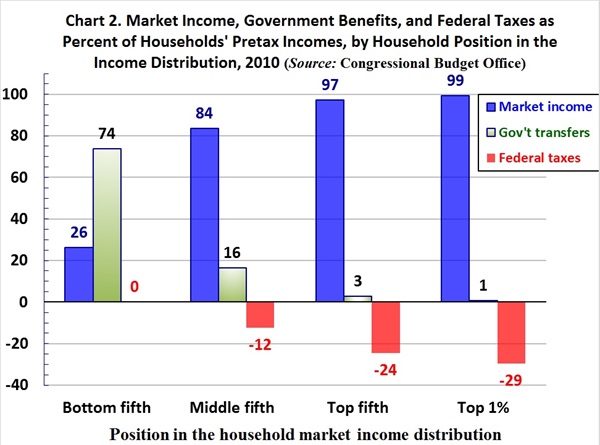 People in the bottom fifth receive $3 in benefits for every $1 that they earn in wages, and pay virtually no net federal taxes. Those in the middle fifth collect more in benefits in the aggregate than they pay in taxes, while those at the top derive a negligible portion of their incomes from transfer payments and forfeit a substantial share of their earnings to the federal government. Piketty’s work took none of this into account.
Valid comparisons between current income disparities and those that existed before the New Deal are possible only if they include the value of social welfare payments. Piketty failed to do that. This omission also casts doubt, not only on his historical comparisons, but also on assertions that middle class income has stagnated in recent decades. If income is broadly understood to include both wages and benefits, it has not. Since the late 1970s, the poorest have seen a 50 percent increase in real net income, while the middle quintile experienced a 36 percent increase. That doesn’t mean that income inequality has been arrested. Far from it. After-tax income for the top 1 percent tripled over the same period.
Krugman acknowledges that Piketty ignored the effects of taxes and transfer payments, but curiously suggests that this omission doesn’t “greatly change the picture.” But if taxing the rich hasn’t “greatly changed the [inequality] picture,” then why does Krugman — in his next sentence — align himself with “populist demands for higher taxes on the rich?”
Inequality’s stubborn paradox is that it appears to have increased alongside policies that the Left insists will reduce it — high taxes on the rich coupled with a robust array of income transfer programs. Those who say that this is because the US doesn’t tax and spend enough should note that, according to Piketty, inequality also has grown in Europe, where taxes are substantially higher and transfer programs much larger than in the US.
It’s not clear why Krugman believes that doubling down on these policies will produce a different result. But that is characteristic of the Left. If many on the Right deny the increase in inequality or dismiss its significance, the Left tends to use it as a symbolic issue to rally their core supporters behind tired policy proposals like tax hikes and minimum wage increases. These policies have not and will not resolve the inequality problem.
The data on inequality, as some of Piketty’s critics have noted, are spotty, the problem complex, its causes elusive. Plenty of work remains to be done by serious policymakers of all ideologies. It is a discussion worth having — one that should welcome the contributions of everyone, including Krugman and his much-despised “deniers.”