


The President and Speaker are headed for another budget confrontation. [Credit: Fox News]
Absent a fresh appropriation of funds, government agencies will close October 1; and unless Congress agrees to raise the government’s credit card limit, Treasury will default on its debt at a yet-to-be-determined date in October or November.
The positions taken by the two parties also are familiar. The President wants a straight increase in the debt ceiling, while Republicans insist on pairing new borrowing with spending reductions. The President says that he will not negotiate with Republicans on this point. On appropriations, House Republicans favor steep cuts in domestic spending programs, but prefer a softer approach to Pentagon spending. A faction of Republicans wants to up the ante, arguing that Congress shouldn’t fund any government agency unless the President agrees to a provision that would prevent the implementation of Obamacare. It is unclear whether GOP leaders will join in making this demand.
The President advocates what he calls a “balanced” approach to deficit reduction – balanced because it includes a mix of spending cuts and tax increases.
A snapshot of federal spending released earlier this month by the Congressional Budget Office (CBO) shows that the deficit is coming down faster than it ever has, though hardly in a balanced way. The deficit will be substantially lower this year than last largely because of tax increases, lower unemployment benefits, and the return to profitability of Fannie Mae and Freddie Mac.
CBO now predicts that this year’s deficit will be $642 billion, down from $1.09 trillion last year. If they’re right, that would be the first year since 2009 that the government borrowed less than $1 trillion and the biggest one-year decline in the deficit ever.
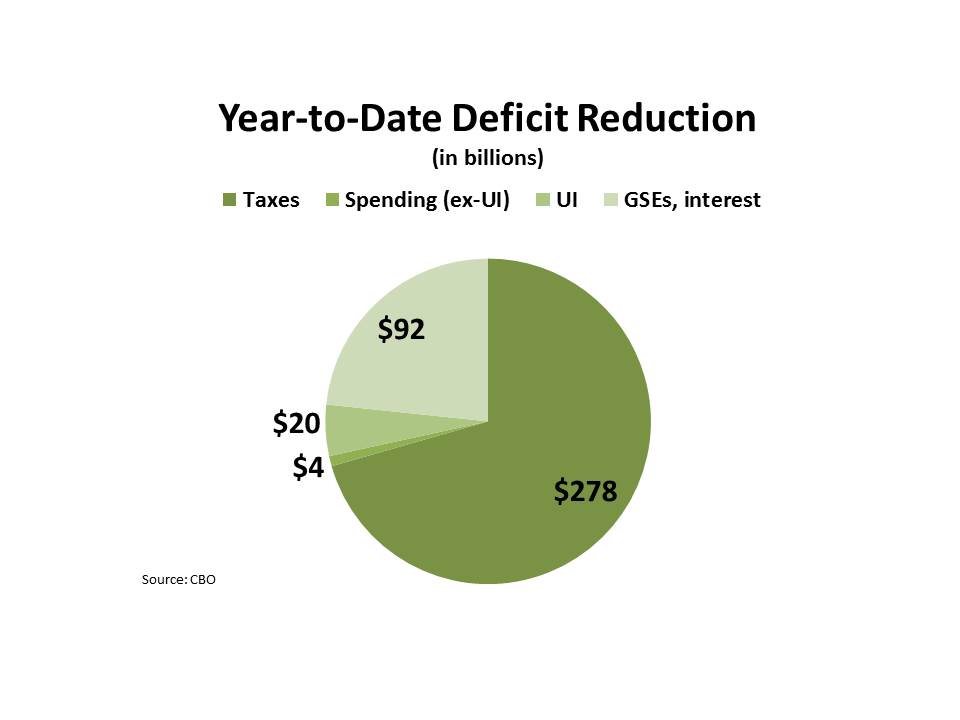
The chart above (click on it to enlarge) shows how that deficit reduction is being achieved.
- Revenues are higher. Through the first ten months of this fiscal year (October 1 – July 31), we’ve paid lots more in taxes of every kind. Some of that is merely due to an economy that is growing, albeit slowly. But some of it, too, is because the President won his standoff with Republicans last winter, getting the tax hikes he’d long sought. Payroll taxes are up for everyone, income taxes are up for the highest earners, and corporate taxes have risen as well, as the Federal Reserve’s bond purchases and zero interest rate policy have helped boost equity markets and corporate profits.
- Spending is flat. With the exception of unemployment insurance (UI), which I’ll discuss below, federal spending is pretty close to what it was last year. The three biggest entitlement programs (Social Security, Medicare and Medicaid) continue to grow robustly; the government has so far spent $1.3 trillion on those three programs alone, $58 billion more than last year. But that increase is offset by cuts in domestic ($25 billion) and military ($36 billion) spending, much of that due to across-the-board cuts (sequestration) that took effect this past March. That nets to about $4 billion less in spending this year, negligible when compared to the nearly $2.9 trillion the government has so far spent.
- UI spending is down. Government spending on unemployment benefits is down by $20 billion, a 24 percent drop over last year. That’s to be expected since the unemployment rate is lower. It’s also because the maximum length of time that a person can collect those benefits has been reduced by 6 months – from 99 weeks to 73 weeks – whether they find work or not.
- Fannie Mae and Freddie Mac are “profitable.” Remember when the government took over mortgage giants Fannie and Freddie back in 2008? For nearly five years, taxpayers ate their losses, as the two firms bled $187 billion. This year, they started to make money. Their profits now go to the Federal Treasury, accounting for an estimated $87 billion in deficit reduction over last year.
If that seems a little gimmicky, well, it is. But it’s not the only gimmick contributing to this year’s historic drop in the deficit. Recall that the Federal Reserve has been buying up $45 billion per month in Treasury bonds. In all, the Fed held nearly $2 trillion in federal debt (and another $1.3 trillion in mortgage-backed securities) as of last week. The Treasury pays interest on this debt to the Fed which – you guessed it – returns those interest payments to the Treasury. Last year, the Fed paid a record $88.4 billion to the Treasury Department, money that also helps reduce the deficit. Here’s how it works: 1) the Federal Reserve “prints money” to buy Treasury debt; 2) the Treasury pays interest on that debt to the Fed; 3) the Fed gives the interest payments back to the Treasury. Voila! $88.4 billion in government “receipts” that help tamp down the deficit.
In a separate but related action, the Fed also has held down interest rates, enabling the government to borrow at very low cost. As a result, the Treasury has so far made about $5 billion less in interest payments than it did last year, despite having to service hundreds of billions of dollars of more debt. The government has borrowed more, but paid less in interest. Go figure.
Together, that combination of higher taxes, flat spending, reduced unemployment benefits and a strange brew of gimmicks are on track to produce substantial deficit reduction. And while it includes something to offend everyone, the policies behind that reduction are much closer to those of the President than to those of Republicans.
That’s certainly true of taxes, which account for over 70 percent of the deficit reduction. Another 23 percent derives from gimmicks that neither party necessarily advocates but both are happy to accept. The UI cuts are cyclical by design, rising and falling with the unemployment rate, a policy that has had bipartisan support since the 1930s. Entitlement spending has followed the trajectory favored by the President, with those programs continuing to grow automatically at uncontrolled rates. With the implementation of his health care law, that spending will go higher still beginning next January.
Sequestration is the only policy that reflects the Republican commitment to reduce spending, although the across-the-board approach is by no means their ideal option. They want to replace some of those cuts, particularly in defense spending, with entitlement savings, something that the President has so far successfully resisted. Failing that, Republicans prefer across-the-board cuts to no cuts at all.
Although he is winning on taxes and entitlement spending, the cuts in domestic discretionary spending continue to trouble the President. He signed a “stimulus” bill on his first day in office that dramatically increased that spending. By 2010, it had reached $658 billion, 26 percent higher than in 2008. In nominal terms, spending has not reached that level before or since; it represented 4.5 percent of GDP, higher than in any year since 1981. The GOP victory in the 2010 Congressional elections produced a sharp reversal in fortunes. The Budget Control Act caps domestic discretionary spending at $469 billion in 2014, below its 2008 level, and House Republicans want to push it lower still.
The President will fight to drive that spending higher this fall and push for more tax increases. He will meet stiff resistance from Congressional Republicans, who want to hold the line on taxes, pare entitlement spending, and delay implementation of Obamacare. All of which makes for entertaining spectacle whose outcome remains uncertain.
To this point, though, the President has prevailed on entitlement spending and taxes. Republicans are getting their deficit reduction but the President is getting his way.