


It may take a bigger gavel for House Budget Committee Chairman Paul Ryan (R‑WI) and his Senate counterpart Patty Murray (D‑WA) to hammer out a budget agreement. (Credit: Swampland Times)
Budget negotiators have struggled for nearly two months to find agreement on the outlines of a spending bill that would fund the government after January 15. The target date for a deal is next Friday. They hope to meet it.
The agreement that continues to elude them, if it comes at all, would be a small one. Gone are aspirations for a “grand bargain” that would reform entitlements and the tax code and replace future across-the-board cuts with something less mindless. Changes to Medicare, Medicaid, Social Security and other “mandatory” spending programs, which together constitute 63 percent of non-interest government spending, are off the table. So, too, are taxes.
The issue they aim to resolve is this: is there a framework acceptable to a majority of the House and Senate to reduce across-the-board cuts in military and domestic spending scheduled for 2014 and 2015?
Chris Van Hollen (D‑MD), the lead negotiator for House Democrats, calls it a “50–50 proposition.” Hal Rogers (R‑KY), who chairs the House Appropriations Committee and who wants a deal to soften sequestration, pronounced himself “somewhat optimistic.”
The Speaker finds himself on unfamiliar ground . For the past three years, problems have emanated from his right flank, with conservative Members last winter scuttling his Plan B and then during the fall forcing him to pursue a strategy that led to a politically damaging government shutdown. Those Members at least somewhat chastened, Boehner’s problems today come from his more moderate colleagues – appropriators like Rogers, who complain that discretionary spending already has been squeezed too much, and defense hawks like Armed Services Committee Chairman Buck McKeon (R‑CA), who fear that another round of automatic cuts will impair military readiness.
The Speaker’s plan to seize the initiative by bringing a stopgap funding measure to the House floor next week has met resistance from these moderates. Rogers told reporters that such an action could undercut negotiations over a possible compromise.
This chart (click on it to enlarge), prepared by the Bipartisan Policy Center, shows in detail the challenge that negotiators face.
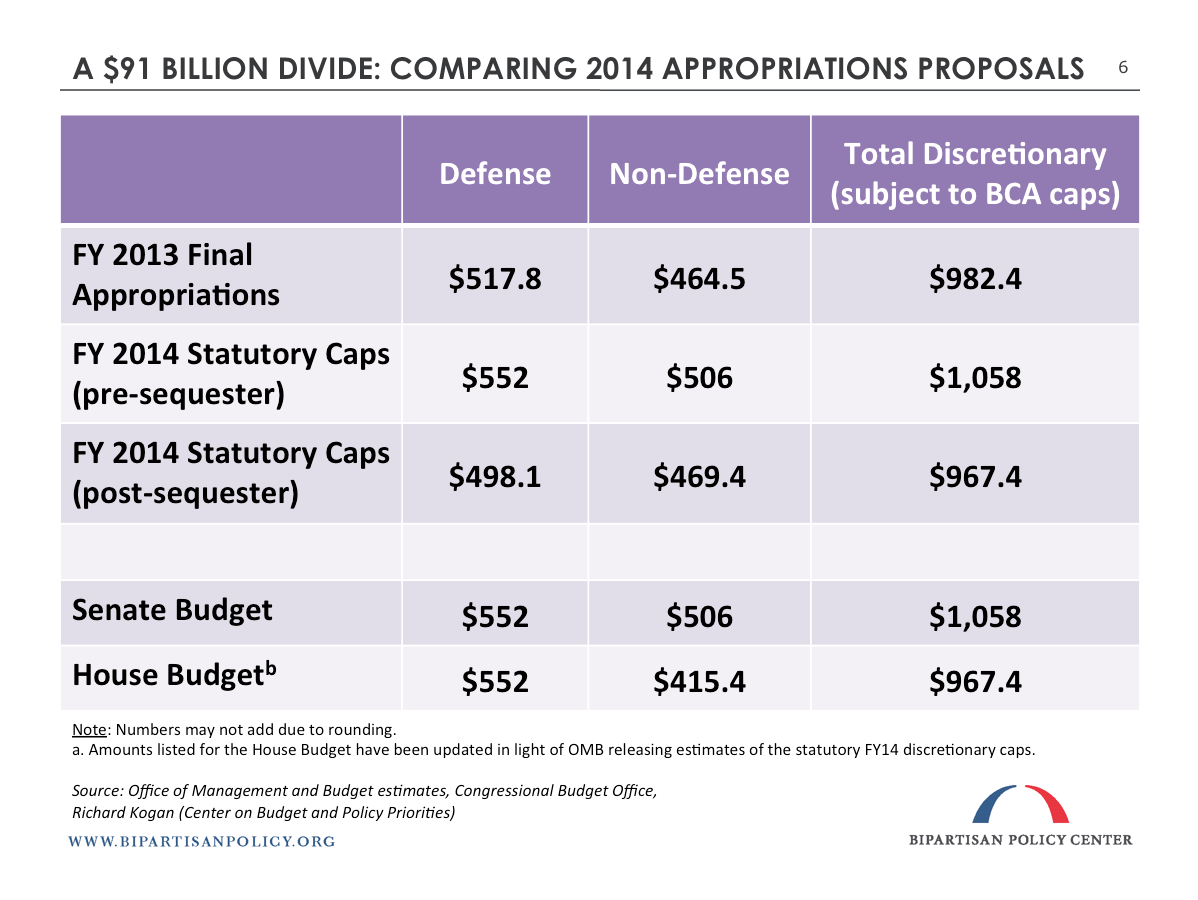
Budget conferees need to close a $91 billion spending gap between the House and Senate. The Senate wants to allocate $1.058 trillion this year (the same as the “pre-sequester” statutory cap), while the House wants to limit discretionary spending to $967 billion (the “post-sequester” statutory cap). Both would appropriate $552 billion for national security, breaching the $498.1 billion post-sequester cap on such spending. The House would cut non-defense discretionary outlays by $49 billion (10.6 percent) below current levels (from $464.5 billion to $415.4). The entire $91 billion gap between the House and Senate budget resolutions thus lies in domestic discretionary spending.
If the two sides can’t agree to some alternative, across-the-board cuts will begin to bite sometime next month. Last time around, sequestration was a clear win for Republicans. Not so this time. Across-the-board cuts now offer positives and negatives to both parties. They would drop overall discretionary spending to $967 billion, a win for Republicans. But defense spending would fall to $498 billion, less than the government currently allocates and $54 billion less than House Republicans seek. Non-defense spending would rise to $469 billion, $5 billion higher than this year and $54 billion more than the House would like to spend.
Sequestration is thus not the slam-dunk win for Republicans that it was last March. Absent some kind of deal to reduce or eliminate the scheduled across-the-board cuts, neither party will be happy with the result.
Negotiators are trying to devise something to make both sides less unhappy, without increasing the deficit — cutting other programs and/or finding revenue to substitute for sequestration. The most obvious solutions are off the table. Republicans have said no to tax increases, and Democrats have said that they can’t abide cuts to entitlement programs. That’s driven budget conferees to the thesaurus, looking for taxes that aren’t taxes, and entitlement cuts that aren’t entitlement cuts as a way to loosen the caps on appropriations. The “not a tax” list includes things like raising 9/11 fees on airline tickets and auctioning broadband spectrum; requiring federal workers to contribute more to their pensions tops the list of “not an entitlement cut.”
If House and Senate conferees could agree to such a list of changes, post-sequester spending caps reportedly might rise from the current $967 billion to a level at or near $1 trillion. That’s still well below the $1.058 trillion the Senate wants and substantially higher than the $967 billion cap that the House has embraced and that sequestration now requires.
It would be, in other words, a compromise and one that would have to be ratified by a majority in both the House and Senate. (Budget resolution conference agreements cannot be filibustered and take effect without requiring Presidential signature.) Such a compromise would allow appropriators to write bills (or, more likely, one big bill, known as an “omnibus” appropriation) for the fiscal year that began last October 1 that complied with the revised caps.
Members will differ over whether any compromise that might emerge from the negotiations is a good one. There are certainly good reasons why a Senator or Representative, regardless of party, might find it unappealing. Compromises, by nature, are rarely obviously good or obviously bad.
The challenge is that many in Congress seem to view compromise as inherently bad. This sentiment is not confined to the Tea Party. Many Democrats, too, equate compromise with capitulation. Some are growing more restive with their leadership, whom they believe have been far too accommodating of Republicans. They fault the President for being insufficiently progressive, just as many Tea Party adherents consider the Speaker insufficiently conservative.
Liberals certainly don’t see John Boehner that way and conservatives can’t imagine how people might regard Barack Obama as a squishy moderate. Yet those perceptions are out there and they will surely color how people view any pending budget deal.
A growing number of Members defines victory as the refusal to compromise, regardless of the result. It is why payroll and income tax increases took effect last January and why they were followed by across-the-board cuts in military and domestic spending that laid waste the policy preferences of both parties. Democrats would rather see their favorite programs slashed than compromise with Republicans. Republicans would rather see the President get the tax hikes he advocated than compromise with Democrats.
All of that seems strange, though, in the context of these budget negotiations. This isn’t a debate about creating a new program or expanding funding for an existing one. It is not a dispute over the government’s proper role, over whether it should redistribute income, raise or reduce taxes, reform entitlements or repeal Obamacare. It’s not about increasing or cutting the deficit or otherwise affecting the government’s debt load. It is not an argument over whether or not to legislate, since Congress must eventually pass a bill to fund the government.
That is not to say that there are no important issues at stake or that the differences between the parties are inconsequential. It is only to say that this is the sort of measure that would seem to lend itself to compromise. That compromise will come only with great difficulty, if at all, on a resolution that avoids the biggest and most contentious fiscal issues is telling.
Politics once was believed to be the art of compromise. Today’s politics is the art of spurning it.