

 Did you cash a check today? Or withdraw money from your savings account? Or use your debit card to buy a sandwich? If so, many Cypriots wish they were you.
The headline is that European leaders reached an agreement with the Cypriot government that will keep the island nation in the Eurozone. For more than a week, Cyprus had teetered on the brink of default, as the government tried to come up with a plan to raise 5.8 billion euro in a way that would please the Troika (European Union, European Central Bank and the International Monetary Fund) without sending its own people into a fury. The troika had set today as the deadline. Absent a solution it deemed acceptable, it would not shell out the 10 billion euro Cyprus would need to prop up its wobbly banks, sending the country into bankruptcy and out of the Eurozone.
The good news is that the Cypriot government met the troika’s terms just ahead of the deadline . And they did it without confiscating money from bank accounts with balances below the insured limit of 100,000 euro, as an earlier failed deal with the troika would have required (See my previous blog post).
But while the government agreed to keep its hands off deposits of less than 100,000 euro, consumers may have a hard time getting their own hands on their deposits.
That’s because the deal’s fine print includes a long list of possible “capital restrictions.” My guess is that you haven’t seen the fine print and maybe don’t know what a capital restriction is. Simply put, these capital restrictions prevent you from doing what you want with your money.
The government of Cyprus is imposing these capital restrictions because they are worried about two things their people might do: 1) take their money out of the banks; and 2) send their money out of the country. Governments and financial institutions care a lot about the latter restriction. One of the principles of the Eurozone is that the currency can flow freely from one European country to another, just as a dollar can be sent online from a customer in New Jersey to a merchant in Montana. In the case of Cyprus, however, there is grave concern that if free flow of capital is permitted, big investors will move their euro out of Cypriot banks (say, to German banks) or even out of the Eurozone entirely (say, to Swiss banks). But restricting this sort of activity can damage big financial institutions that have to move large sums of money across borders quickly. So European officials are busy assuring Wall Street and heavy hitters everywhere that these restrictions “may only last a few days”. That remains to be seen.
The average person, though, is much more concerned about restrictions that the government may place on control of his or her own account. Access to this money doesn’t involve financial speculation; it’s used for much less exotic things like paying a bill or cashing a check.
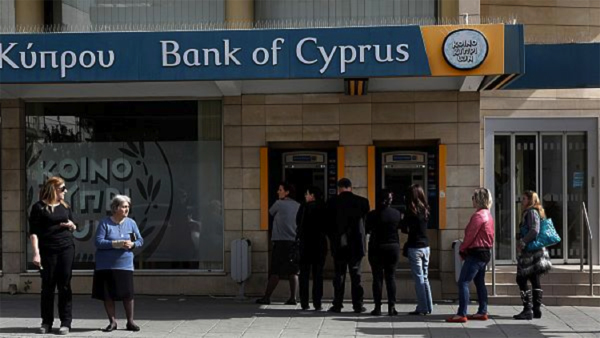
And this is where the consequences of the deal get real for ordinary Cypriots. They’ve been coping with the biggest and ugliest capital restriction since March 15. The banks closed that afternoon and haven’t reopened since. They will remain closed “indefinitely,” although the government ordered banks to restock ATMs daily, giving customers at least limited access to their funds.
To protect banks from their customers once they do reopen, Parliament has given the finance minister power to impose a long list of restrictions on consumers. These include:
- Bans or restrictions on check-cashing;
- Restrictions on use of credit, debit and prepaid cards;
- Ban on early withdrawal from certificates of deposit (CDs), along with requirements that CDs be rolled over once they mature;
- Requirements that savings accounts be converted to CDs;
- Ban or restriction on opening new accounts;
- Restrictions on transfers of money to other banks; and
- Any other control measure that the minister or governor will deem necessary under the circumstances for reasons of public order and safety.
Even without that last catch-all authority, this power is pretty ominous. It means that after you’ve earned your money, paid taxes on it, paid your bills and still managed to set some aside in a bank account, the government can keep you from using it when you need it.
That’s quite a price to pay for a bailout. It may not be as bad as the tax on insured deposits that the Cyprus Parliament rejected, but it is a real price and one that consumers will actually see.
Like Cypriots before this rude awakening, we’re not aware of the many unseen costs we incur to keep the financial services system functioning. We pay hidden fees, like the “swipe fee” that banks collect whenever we use our credit or debit cards. We bear the costs of maintaining federal insurance on our checking and savings accounts, though these costs are neither transparent nor obvious. More subtly still, people who have managed to save money are paying the price, in the form of miniscule rates of interest, of a long-standing Federal Reserve policy of allowing banks to borrow at near-zero rates.
The financial services system, like our health care system, does a great job of concealing its costs from consumers. That may or may not be a bad thing, but it’s worth recognizing that you’re not really getting something for nothing from your friendly neighborhood bank.
It’s also worth remembering that if the banks need to be bailed out again, the government will present you with the bill. Don’t be surprised if that next bill looks a bit like the one the Cypriots just got.